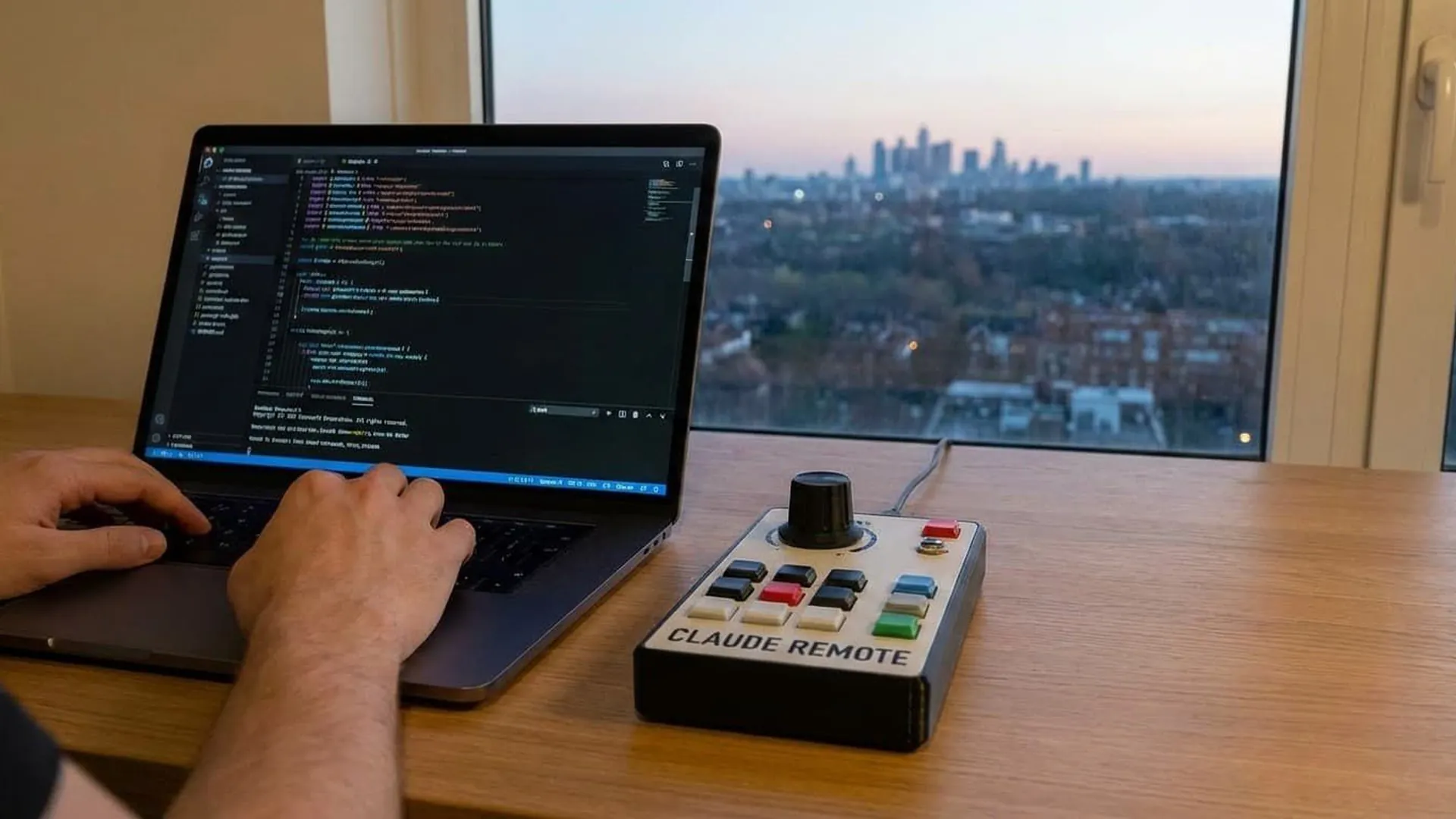
Claude Code Remote: How Anthropic's AI Agent is Transforming Software Development
On February 24, 2026, Anthropic released the Remote Control feature as a Research Preview. Claude Code Remote is far more than a feature update: it represents the latest component in a strategy transforming AI-assisted software development from autocomplete to full agent systems. With an annualized run rate of 2.5 billion USD, 29 million daily VS Code installations, and approximately 4 percent of all public GitHub commits, Claude Code opens new possibilities for IT transformation, SAP migration, and process automation.
What is Claude Code and What Makes Remote Different?
Claude Code is Anthropic's agentic coding tool that runs directly in the terminal, VS Code, JetBrains, as a desktop app, or on the web. Unlike traditional autocomplete tools like GitHub Copilot in its basic version, Claude Code is a complete software engineering agent : it reads codebases, edits files, executes terminal commands, manages Git workflows, and iterates independently over error messages.
At its core, Claude Code works in what is called an agentic loop with three phases: gathering context (reading files, understanding project structure), executing actions (writing code, running commands), and verifying results (running tests, checking outputs).
The Three Operating Modes of Claude Code Remote
| Mode | Where Does Code Run? | Use Case |
|---|---|---|
| Remote Control | Locally on your own machine | Continue running session from smartphone or browser |
| Claude Code on the Web | On Anthropic's cloud infrastructure | Parallel tasks, no local setup required |
| SSH Sessions | On a remote server, VM, or DevContainer | Full access to remote machine |
The new
Remote Control feature
is conceptually particularly interesting: Claude continues to run on the developer's local machine. The mobile or web interface is merely a window into this local session. File system, MCP servers, tools, and project configuration remain fully available locally. It starts with
claude remote-control
in the terminal, which displays a QR code that can be scanned with the Claude app or opened as a URL in the browser.
Technical Details
- Only outgoing HTTPS connections, no incoming ports
- Currently available for Pro and Max subscribers (Research Preview)
- Only one remote session at a time, terminal must remain open
- Sessions end after network interruptions exceeding 10 minutes
Architecture, Security, and MCP Integration
The Agentic Architecture in Detail
Claude Code differs fundamentally from autocomplete tools through its tool-use architecture . When starting in a directory, Claude gains access to the project (files and subdirectories), the terminal (build tools, Git, package managers), Git state (branch, uncommitted changes, history), and the CLAUDE.md configuration file.
Isolated context windows for subtasks that can work in parallel
Multiple coordinated Claude instances with lead agent coordination
Shell commands executed before or after Claude actions
Connections to external data sources like Jira, Slack, or databases
The Agent Teams feature, introduced with Opus 4.6 in February 2026, allows multiple Claude instances to work in parallel on different parts of a problem. A lead agent coordinates the work of teammates. Starting with 3 to 5 teammates and 5 to 6 tasks per agent is recommended. Token consumption is approximately 7 times that of a standard session.
Security Model
Claude Code's security model is based on multiple layers:
For enterprise customers, Anthropic additionally offers: Zero Data Retention (no data storage on Anthropic servers), Managed Policies for organization-wide enforcement of security guidelines, Compliance API for real-time access to usage data, SOC 2 Type 2 and ISO 27001 certifications, and HIPAA-capable infrastructure.
MCP: The Model Context Protocol
The Model Context Protocol (MCP) is an open standard that connects Claude Code with external data sources and tools. Through MCP, you can read design documents from Google Drive, update tickets in Jira, pull data from Slack, or establish database connections. MCP has become the de facto standard for AI tool integration in 2025/2026, with over 1,000 community-developed servers .
Agentic Coding vs. Autocomplete: A Paradigm Shift
The evolution of AI-assisted software development can be divided into three generations:
Generation 1 (2021-2023)
Autocomplete: Line-by-line code suggestions, reactive, passively waiting
Generation 2 (2023-2024)
Context-aware assistants: Chat-based, multi-file capable, project-oriented
Generation 3 (2025+)
Agentic coding: Autonomous agents that understand repositories, formulate multi-step plans, run tests, and iterate on errors
The numbers support this shift: 92 percent of US developers use AI tools daily in 2026. Gartner recorded a 1,445 percent increase in inquiries about multi-agent systems from Q1 2024 to Q2 2025. Microsoft reports that AI already writes 30 percent of its code, Google puts the figure at 25 percent.
Competitive Landscape
| Tool | Strength | Limitation | Price |
|---|---|---|---|
| GitHub Copilot | 82% enterprise adoption, broad IDE support | 8,192-token context window | from 10 USD/month |
| Cursor | Parallel subagents, VS Code-familiar interface | Proprietary fork strategy, vendor lock-in | from 20 USD/month |
| Windsurf | Best autocomplete speed | Uncertain future after failed OpenAI deal | from 15 USD/month |
| Claude Code | 200,000-token context, Enterprise via Bedrock/Vertex | Terminal-first can be an entry barrier | approx. 6 USD/day (API) |
Enterprise Use Cases: From Spotify to Wall Street
Over 650 agent-based pull requests are merged into production monthly. For complex code migrations, Spotify reports time savings of up to 90 percent. Senior engineers have "not written a single line of code themselves since December 2025."
With the NovoScribe platform, the creation of regulatory approval documents was reduced from 10+ weeks to 10 minutes . A team of 11 people reportedly works like many times its size.
Agents autonomously implement instructions from a Jira ticket through to committed code. CTO Sridhar Masam describes this as a shift "from risk avoidance to risk calibration" in regulated environments.
30 percent improvement in code delivery velocity with throughput of over 100 billion tokens per month.
Anthropic itself reports internally a 67 percent increase in merged PRs per developer per day, with 70 to 90 percent of code created with Claude Code assistance.
Energy Sector and Utilities: Where AI Coding Has the Greatest Impact
For the European energy sector, characterized by simultaneous energy transition, decarbonization, decentralization, and digitalization, AI-assisted software development offers particularly significant potential. The challenges are well known: skills shortage, complex regulatory requirements (NIS2, critical infrastructure), smart meter rollouts, and the upcoming SAP S/4HANA migration for many utilities.
Over 35 production-ready Claude Code plugins for SAP BTP, CAP, Fiori, ABAP, HANA. For migration to S/4HANA, AI-assisted code remediation achieves success rates of 70 to 80 percent .
Over 70 percent of global energy infrastructure is older than 25 years. Claude Code supports predictive maintenance, anomaly detection, and real-time grid optimization.
Automation of meter reading collection, dunning procedures, bank data changes. Octopus Energy achieves 80 percent customer satisfaction with AI-generated email responses.
Modern Systems converted 8.5 million lines of COBOL to Java with 99.5 percent accuracy for a US healthcare provider, in months rather than years.
Compliance in the European Context
GDPR and EU AI Act
- The EU AI Act provides for fines of up to 35 million euros or 7 percent of global revenue
- Claude Code via AWS Bedrock and Google Vertex AI: code never leaves the enterprise environment
- Anthropic explicitly does not train on Claude-for-Work data
- Zero Data Retention, SOC 2 Type 2, and ISO 27001 certifications available
Best Practices: CLAUDE.md, Prompting, and Secure Remote Usage
CLAUDE.md as a Strategic Control Instrument
The CLAUDE.md file in the project root is read at every session start and serves as persistent memory for project standards, architecture decisions, preferred libraries, and build commands. The recommended structure follows the WHAT/WHY/HOW principle.
Recommendations for CLAUDE.md
- Less than 300 lines, under 60 lines in root is ideal
- Claude Code can reliably follow about 150 to 200 instructions
- Every line competes with actual work context for attention
- File should be versioned and shared within the team
Prompting Strategies
1. Plan Mode
First switch to Plan Mode (Shift+Tab twice), then research with targeted questions
2. Provide Context
Reference files directly via @ syntax, pass error messages in full
3. Implementation
Request implementation plan, then switch to Normal Mode for execution
4. Iteration
80 percent of bugs are resolved in fewer than three exchanges with full context
Security in Remote Operation
If not needed, disable hooks for additional security
Only enable explicitly trusted MCP servers
Block curl, wget, and .env access
Sandbox in Docker or VMs, never run as root
Outlook: Where AI Coding is Headed by 2027
Anthropic's own trends report for 2026 identifies eight developments. The most important: the software development lifecycle is changing dramatically. Engineers are shifting from writing code to orchestrating agents. Individual agents are giving way to coordinated teams. Long-running agents build complete systems over hours and days.
At the same time, differentiated voices urge caution. Entry-level hiring at the top 15 US tech companies has fallen 55 percent since 2019. For companies, this means: the most valuable skills are shifting toward architecture understanding, agent coordination, and the ability to critically evaluate AI-generated code.
Conclusion: What This Means for Enterprises Now
Claude Code Remote is not an isolated feature. It signals the direction of software development as a whole. The combination of agentic behavior, remote access, enterprise security, and a growing ecosystem (MCP, SAP plugins, CI/CD integration) makes Claude Code a serious tool for IT transformation.
The shift from autocomplete to agents is comparable to the transition from waterfall to agile
Via Bedrock/Vertex, full data sovereignty for agentic coding in Europe for the first time
Especially for SAP migrations and legacy systems, AI-assisted coding can provide the decisive lever
The question is not whether but how quickly companies create the organizational prerequisites