Hermes Agent 2026: First Production-Ready Self-Improving Open-Source AI Agent
Nous Research released Hermes Agent v0.10 on 16 April 2026, a self-improving open-source agent. The project is growing faster than LangChain and AutoGen combined. For European decision-makers, the question is whether a credible alternative to proprietary agent platforms has now emerged.
Hermes Agent is an open-source AI agent framework from Nous Research, first released on 25 February 2026. Version 0.10.0 from 16 April 2026 bundles 118 skills, three-layer memory, and six messaging integrations. Seven weeks after release, the project passed 95,600 GitHub stars and has since exceeded 103,000. Its technical differentiator is GEPA, an ICLR 2026 Oral-accepted self-improvement mechanism that makes agents with 20 or more self-generated skills 40 percent faster on repeated tasks. Self-hosting on European infrastructure starts at 5 euros per month, and the MIT license prevents vendor lock-in. For European enterprises, the framework is a strategically interesting option; for enterprise-grade production use it still needs more maturity, audit logging, and clear governance.
What Hermes Agent is and why it matters now
Nous Research released Hermes Agent v0.10.0 on 16 April 2026. Seven weeks after the first release on 25 February 2026, the project passed 95,600 GitHub stars and matched the historical growth curves of LangChain and AutoGen combined. For you as a decision-maker, this means Hermes Agent is no longer a research project. It is a framework you can run on your own server with production-ready self-improvement.
The pace is striking. Release v0.8.0 on 8 April 2026 merged 209 pull requests and closed 82 issues. Only eight days later came v0.10.0 with the next layer of maturity: three memory tiers, six messaging gateways, and a closed learning loop. That is the release cadence of a well-funded research lab, not a hobby project.
Initial release
Nous Research ships Hermes Agent on GitHub under MIT license, positioned as "the open-source agent that grows with you".
Version 0.8.0 with GEPA self-evolution
209 merged PRs, 82 closed issues, native Google AI Studio integration, MCP OAuth 2.1 with PKCE, and the first production release with GEPA-based skill optimization.
Version 0.10.0 with 118 skills
Current release with three-layer memory, six messaging integrations, and a closed learning loop that generates reusable skills from experience.
The three pillars: memory, skills, model agnosticism
Hermes Agent differentiates itself from established frameworks such as LangChain, CrewAI, or the Microsoft Agent Framework through three design decisions: persistent multi-layer memory, automatic skill generation from solved work, and strict model independence. The combination makes it the first open-source system with practical self-improvement.
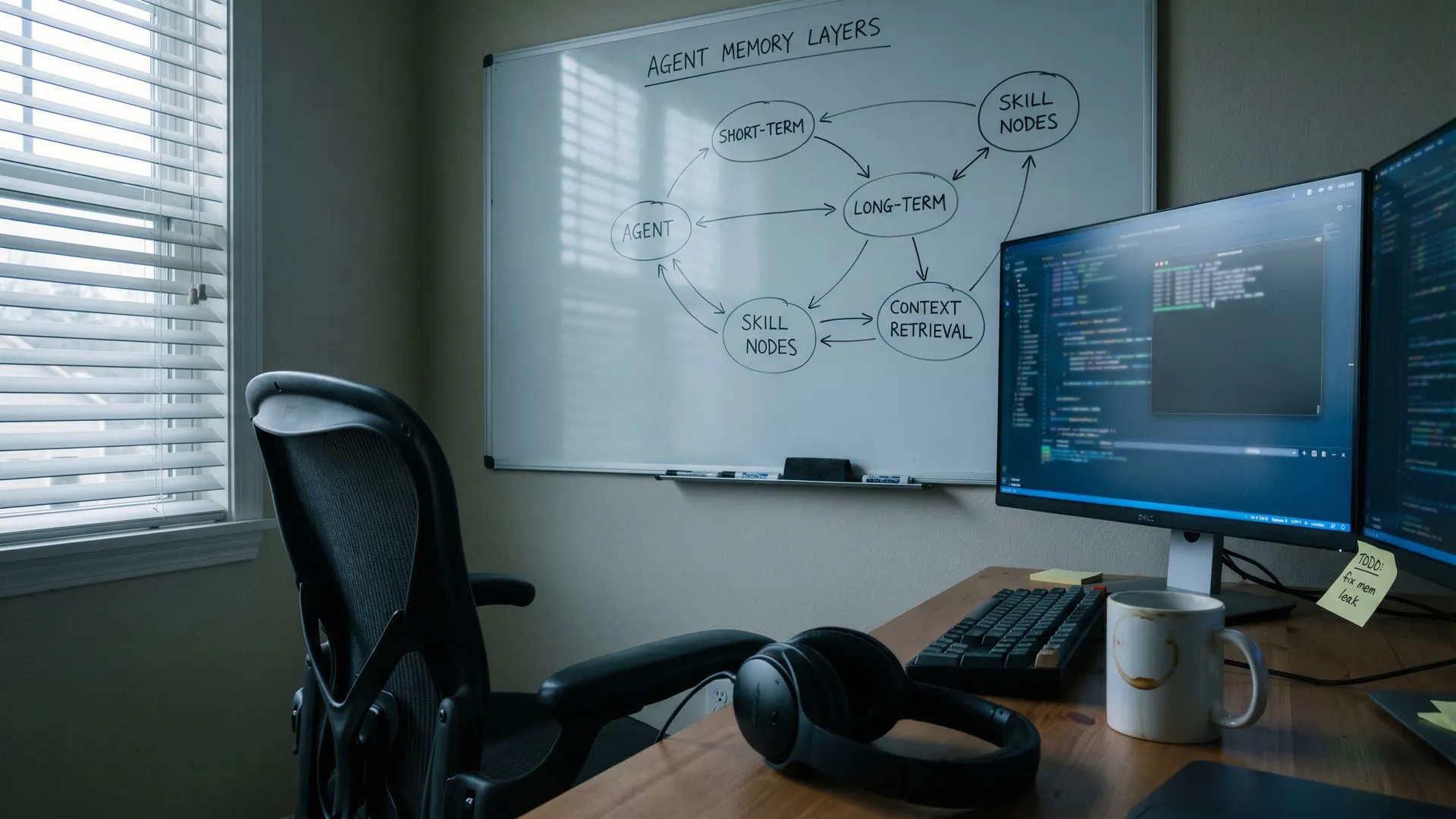
Three-layer memory
Short-term context for the current session, persistent long-term conversations with FTS5 full-text search, and procedural skill memory with LLM summarization. Together the layers produce a model that can retrieve tasks from weeks ago.
Automatic skill creation
After complex tasks, the agent writes reusable skill documents on its own. These skills are refined during use and reinforced through periodic prompts in memory.
Model agnosticism
Supported providers include Nous Portal, OpenRouter with 200+ models, NVIDIA NIM, Xiaomi MiMo, z.ai GLM, Kimi Moonshot, MiniMax, Hugging Face, OpenAI, and custom endpoints. Live model switching works mid-session without a restart.
At the core is GEPA, a method introduced by Gupta and colleagues. GEPA stands for Genetic-Pareto and uses large language models to analyze complete execution traces. Instead of collapsing a reinforcement-learning reward into a single scalar, the system reads error messages, profiling data, and reasoning chains, and proposes targeted prompt improvements. The paper was accepted as an Oral at ICLR 2026.
GEPA lets open-source models such as gpt-oss-120b beat proprietary frontier models on enterprise tasks by about 3 percent, at 20 to 90 times lower cost.
The 40 percent figure is a speed gain on domain-similar tasks, not a quality gain. GEPA makes the agent more efficient, not smarter. For routine pathways this matters; for new domains or principled decisions there is no automatic benefit.
Deployment, costs, and integrations
Hermes Agent runs on Linux, macOS, WSL2, and Android via Termux. Installation is a single shell command. For personal use, a VPS with 1 vCPU and 1 GB RAM at 5 euros per month (Hetzner, IONOS, or similar) is enough. For team deployments with always-on operation and multiple messaging gateways, independent reviews recommend 2 vCPU and 4 GB RAM.
| Component | Requirement | Cost (estimate) |
|---|---|---|
| Framework license | MIT, no usage caps | 0 euros |
| VPS (personal use) | 1 vCPU, 1 GB RAM | from 5 euros per month |
| VPS (team, always-on) | 2 vCPU, 4 GB RAM | from 15 euros per month |
| LLM cost per complex task | Budget models such as Claude Haiku 4.5, GPT-5.4 Mini, Hermes 4 70B | about 0.30 US dollars |
| Messaging integrations | Telegram, Discord, Slack, WhatsApp, Signal, Email, CLI | included in the framework |
| Sandbox backends | local, Docker, SSH, Singularity, Modal | variable, depends on Modal usage |
The sandbox choice is a meaningful differentiator. Hermes Agent separates tool-call execution into five backend options. For critical deployments, tools can run in isolated Docker containers or via SSH on secured remote hosts. Combined with the already integrated MCP OAuth 2.1 PKCE authentication standard and OSV malware scanning for MCP extensions (shipped in v0.8.0), the security architecture is unusually solid for a seven-week-old project.
PRs in v0.8
Merges in eight days demonstrate development velocity and community engagement.
LLM providers
From Nous Portal via OpenRouter with 200 models down to local endpoints. No single-vendor dependency.
Contributors
Over 500 developers have already contributed. Strong participation from the open-source community.
European perspective
Hermes Agent hits a nerve in the digital sovereignty debate. According to Bitkom, 99 percent of European enterprises want digital independence, but only 57 percent have an exit strategy for non-EU software. A self-hosted open-source agent on European infrastructure addresses exactly this gap. France's April 2026 move to order an exit from non-EU software makes the topic politically unavoidable.
Microsoft released the Agent Governance Toolkit on 2 April 2026 under MIT license. The toolkit covers the OWASP Agentic Top 10 and the EU AI Act, with 20 adapters for LangChain, CrewAI, Google ADK, and Microsoft Agent Framework. Even though Hermes Agent is not listed as an explicit adapter yet, the move signals that infrastructure for open-source governance is being built right now.
Hermes Agent vs OpenClaw and proprietary platforms
Hermes Agent competes directly with OpenClaw, the largest open-source agent by reach. OpenClaw has five and a half times more GitHub stars, but a very different security record. Choosing between the two comes down to ecosystem breadth versus learning depth.
| Aspect | Hermes Agent | OpenClaw |
|---|---|---|
| GitHub stars | 103,000+ | 345,000+ |
| Messaging integrations | 6 (curated) | 50+ (broad) |
| Skills | 118 (curated) | 2,857 ClawHub |
| Learning mechanism | GEPA, autonomous skill creation | Session-based, skill ecosystem |
| Memory architecture | FTS5 plus LLM summarization, three layers | Session-based with auto-notes |
| CVEs since January 2026 | 0 | 9 incl. CVE-2026-25253 (CVSS 8.8) |
| Supply chain incidents | none known | ClawHavoc with 341 malicious skills |
| Maturity | young, fast iteration | established, governance partners |
OpenClaw's explosive growth exposed infrastructure readiness gaps. Microsoft and Cisco issued their own cautions about running it on standard infrastructure. Hermes Agent's smaller footprint and stricter vetting have avoided comparable public incidents so far.
The New Stack, April 2026Compared to proprietary platforms such as SAP Joule , Microsoft Copilot Studio, or Salesforce Agentforce, Hermes Agent offers a very different value proposition. No license fees, no mandatory cloud migration, full data sovereignty, but also less deep integration into ERP or CRM systems. The choice depends on whether your use case lives in documented enterprise processes or in flexible, technically creative automation.
Challenges and risks
Hermes Agent is young and not ready for every enterprise scenario. Independent assessments from European mid-market reviewers in March and April 2026 are cautious. Too early for production use in regular operations, too little documentation for large rollouts, too little community support for critical paths.
API stability
Between v0.x releases, API stability is not guaranteed. Version pinning is explicitly recommended, and upgrade paths must be actively curated.
Memory opacity
What the agent has learned and stored is hard to audit. For GDPR and the EU AI Act, dedicated audit tooling is needed that Hermes does not ship with.
Attack surface
A permanently running systemd service with five messaging gateways is a sizable attack surface. The gateway itself must be locked down carefully.
One more point: Hermes Agent is not built as a code generation platform. For coding agent workflows , Claude Code, Aider, or Cursor are better fits. Hermes aims at persistent conversation, task automation, research, and routine orchestration. Skill quality varies on complex multi-phase tasks, especially when domain knowledge is thin.
What companies should do now
For most European enterprises, Hermes Agent is a strategic option in April 2026, not a production system. The right stance is a pilot under controlled conditions, enough to understand the self-improving approach and calibrate future decisions against proprietary platforms.
Run a scout
Assign a technology scout to track Hermes Agent as a reference for self-improving approaches. Read release notes, follow GitHub issues, assess community activity.
Launch an isolated pilot
Set up a pilot for developer productivity, research assistance, or routine automation. Do not integrate with production customer data processes.
Test EU self-hosting
Deploy Hermes Agent on a European VPS such as Hetzner or IONOS. Verify network isolation, firewall rules, and credential management.
Plan audit logging
Plan memory inspection and audit logging from the start. Do not retrofit. The EU AI Act requires documented decision logic.
Use model agnosticism
Use budget models for routine tasks, frontier models only for critical paths. Live switching allows fine-grained cost control without rewrites.
Run a security review
Conduct a security review of messaging gateway deployments before connecting real accounts. The systemd service is an extended attack surface.
Further reading
Frequently asked questions
Hermes Agent is an open-source AI agent framework from Nous Research, first released on 25 February 2026. The agent runs on your own server, stores conversations persistently, automatically creates new skills from solved tasks, and is freely usable under the MIT license. Version 0.10.0 from 16 April 2026 bundles 118 skills, three-layer memory, and six messaging integrations.
Hermes Agent is the first open-source agent with production-ready self-improvement based on GEPA. Agents with 20 or more self-generated skills are 40 percent faster on repeated tasks in the same domain, according to Nous Research. The project reached 95,600 GitHub stars in seven weeks, faster than LangChain and AutoGen combined. Add strict model agnosticism with 15+ LLM providers and a consistent MIT license without an enterprise tier.
The framework itself is free under MIT license. Self-hosting on a European VPS starts at 5 euros per month for personal use with 1 vCPU and 1 GB RAM. Team deployments with always-on operation need 2 vCPU and 4 GB RAM, available from about 15 euros per month. LLM costs are about 0.30 US dollars per complex task using budget models such as Claude Haiku 4.5, GPT-5.4 Mini, or Hermes 4 70B.
Only to a limited extent. Documentation is incomplete, the community is young, and API stability between v0.x releases is not guaranteed. For pilot projects covering developer productivity, research assistance, or routine automation, Hermes Agent is a reasonable option. For critical ERP or customer-data processes, enterprises should currently stick with more established platforms such as SAP Joule or Microsoft Copilot Studio, or wait for a more mature release.
Hermes Agent maps well to GDPR requirements through self-hosting on European infrastructure. For the EU AI Act starting 2 August 2026, additional audit logging, transparency documentation, and a skill vetting process are required. Microsoft released its Agent Governance Toolkit on 2 April 2026 under MIT license, which provides compliance patterns for open-source frameworks and covers the OWASP Agentic Top 10 as well as EU AI Act requirements.
OpenClaw has more reach with 345,000 GitHub stars and over 50 messaging integrations, but faced nine CVEs in March 2026 including CVE-2026-25253 with CVSS 8.8, plus the ClawHavoc supply chain attack with 341 malicious skills. Hermes Agent is smaller with 6 messaging integrations and 118 curated skills, free of known CVEs so far, and more focused on learning architecture and security. OpenClaw wins on ecosystem breadth, Hermes on learning depth and security posture.
GEPA stands for Genetic-Pareto and is a method for automatic prompt and skill optimization. Unlike reinforcement-learning approaches that condense execution traces into a single reward scalar, GEPA uses an LLM to read full traces with error messages, profiling data, and reasoning chains, then proposes targeted fixes. The paper was accepted as an Oral at ICLR 2026 and, according to Databricks Research, enables open-source models to beat proprietary frontier models on enterprise tasks at 20 to 90 times lower cost.